
AISI 4140 Steel: A Complete Guide for Buyers and Engineers
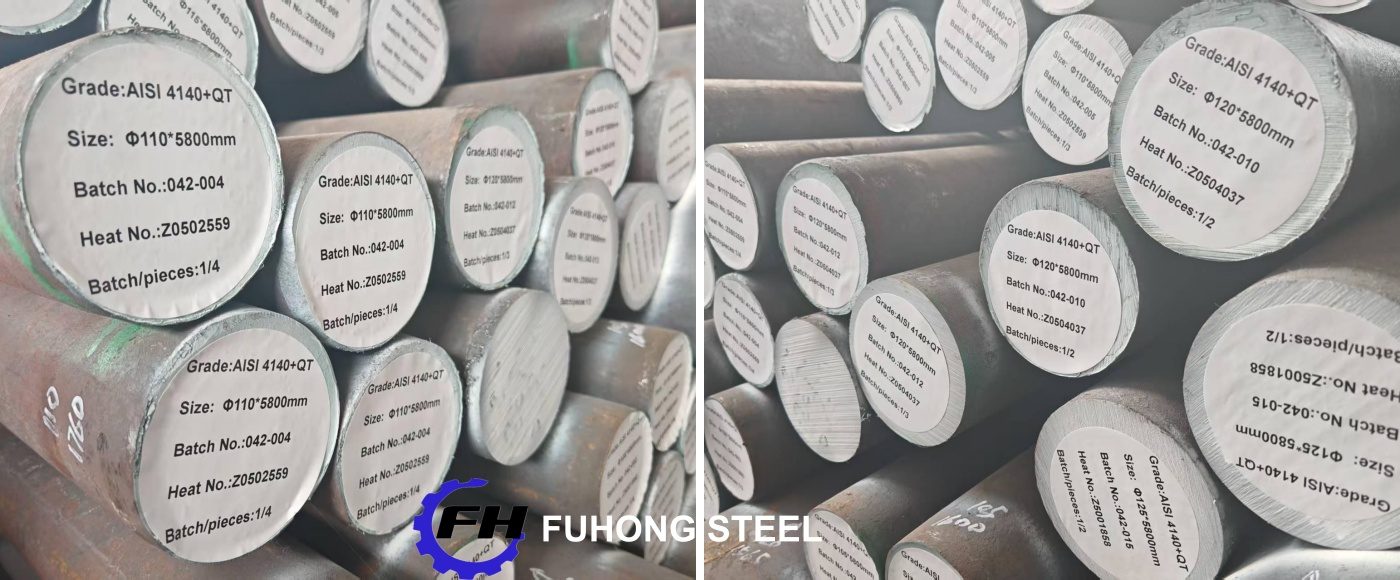
AISI 4140 is the workhorse of chromium-molybdenum alloy steels — prized for its excellent balance of strength, toughness, and hardenability at a competitive price point. Whether you’re specifying shafts, gears, bolts, or tooling, this guide covers everything you need to know to make the right purchasing decision.
What Is AISI 4140 Steel?
AISI 4140 is a chromium-molybdenum (Cr-Mo) low alloy steel defined by the AISI/SAE 41xx series. It contains approximately 0.40% carbon, 1.0% chromium, and 0.20% molybdenum — a combination that delivers reliable through-hardening performance in medium-section parts up to roughly 50 mm (2 inches) in diameter.
It is most commonly supplied in the quenched and tempered (QT) condition, where it achieves a well-balanced combination of tensile strength (850–1000 MPa), yield strength (≥670 MPa), and impact toughness. Its density is 7.85 g/cm³, consistent with standard carbon and low-alloy steels.
Because of its predictable heat-treating response and broad availability, 4140 is the default choice for engineers designing moderately stressed components in automotive, machinery, oil & gas, and general manufacturing.
Equivalent International Grades
4140 is recognized under several standard designations worldwide:
Why Choose 4140? Four Core Advantages
Good hardenability
Good hardenability for medium-section parts
Cost-effective compared
Cost-effective compared to higher alloys
Excellent strength-toughness
Excellent strength-toughness balance
Versatile across
Versatile across many industries
4140 Steel Chemical Composition
The precise balance of alloying elements gives 4140 its characteristic hardenability and mechanical profile. Below are the nominal composition ranges per AISI/SAE specification:
| AISI 4140 Chemical Composition (Weight %) | ||||
| Element | Symbol | Min (%) | Max (%) | Range |
| Carbon | C | 0.38 | 0.43 | 0.38-0.43 |
| Silicon | Si | 0.15 | 0.35 | 0.15-0.35 |
| Manganese | Mn | 0.75 | 1.0 | 0.75-1.0 |
| Phosphorus | P | — | 0.035 | ≤0.035 |
| Sulfur | S | — | 0.04 | ≤0.04 |
| Chromium | Cr | 0.8 | 1.1 | 0.8-1.1 |
| Molybdenum | Mo | 0.15 | 0.25 | 0.15-0.25 |
4140 Steel Mechanical Properties -QT Condition
The values below represent typical mechanical properties of AISI 4140 in the quenched and tempered (QT) condition at a 25 mm (1 in) section size. Actual properties may vary with section thickness, heat treatment parameters, and testing direction.
| Typical Mechanical Properties — Quenched & Tempered |
||||
| Property | Symbol | Value | Unit | Condition |
| Tensile Strength | Rₘ | 850 – 1000 | MPa | QT |
| Yield Strength | Rₚ₀.₂ | ≥ 670 | MPa | QT |
| Elongation | A₅ | ≥ 13 | % | QT |
| Hardness | HRC | 28 – 34 | HRC | QT |
Notes on Specifying
- Section size matters. Hardenability limits through hardening to approximately 50 mm (2 in) diameter. Larger sections will show a hardness gradient from surface to core.
- Tempering temperature can be adjusted to dial in the desired strength-to-toughness ratio. Higher tempering = more toughness, lower strength.
- As-supplied condition varies by mill. Always confirm whether you’re receiving annealed, normalized, or pre-hardened QT material at the time of order.
4140 Steel Common Applications
4140 is one of the most widely specified alloy steels in industrial manufacturing. Its combination of strength, machinability, and cost makes it a go-to material across four major sectors:
Automotive
- Crankshafts
- Gear shafts
- Connecting rods
- Bolts
Oil & Gas
- Drill collars
- Valve bodies
- Tool joints
Machinery
- Spindles
- Gears
- Shafts
- Hydraulic parts
Tooling & General
- Die holders
- Fixture plates
- Fasteners
Buyer’s tip: For high-volume automotive and machinery components, 4140 is almost always the most cost-effective choice when hardness requirements fall between 24–36 HRC. Only step up to 4340 or other higher alloys when section size or fatigue requirements demand it.
4140 Steel Heat Treatment Basics
4140 responds well to heat treatment and is most commonly used in the quenched and tempered condition. Below are the standard processes and typical temperature ranges:
Quenching
840–875°C
Normalizing
870–900°C
Tempering
550–650°C
Annealing
810–840°C
Recommended QT Cycle For 4140 Steel
- Austenitize at 845–860°C (1550–1580°F), hold time based on section thickness (approximately 1 hour per 25 mm).
- Quench in oil or polymer. Water quenching increases distortion and cracking risk and is generally not recommended.
- Temper immediately after quenching at 550–650°C (1020–1200°F), adjusting temperature to achieve target hardness. Hold for 1–2 hours per 25 mm of section.
- Cool in still air. For large sections, consider a controlled cool to minimize residual stress.
4140 Steel Machinability & Weldability
Practical guidance for buyers and fabricators working with 4140:
Machinability
4140 has good machinability in the annealed or normalized condition. In QT condition, use carbide tools and moderate feeds. Pre-hardened 4140 (28-32 HRC) is widely used for direct machining.
Machining Tips
- Use carbide inserts for production machining of QT material
- Pre-hardened 4140 (28–32 HRC) is ideal for direct-machined parts
- Maintain rigid setups and sharp tooling to avoid work-hardening
- Use coolant generously — especially in drilling and tapping
Weldability
4140 can be welded but requires preheating (200-300°C) and post-weld heat treatment to avoid cracking. Low-hydrogen electrodes are recommended. Not ideal for heavy welded structures.
- Preheat to 200–300°C (390–570°F) before welding
- Use low-hydrogen electrodes (E7018 or similar)
- Post-weld heat treatment (PWHT) is strongly recommended
- For weld-heavy structures, consider 4130 or A36 instead
4140 Steel Available Forms & Sizes
4140 is stocked in a wide range of product forms. Standard inventory typically includes:
Round
Φ14-Φ1000 mm
Square
100-500 mm
Flat/Blocks
T:120-800 x W:120-1500mm
Shafts
Customized upon request
4140 vs 4340 vs 4130: How to Choose
The 41xx and 43xx series are often compared. Here’s a quick reference to help you select the right grade for your application:
| Grade Comparison Table | |||
| Property | AISI 4140 | AISI 4340 | AISI 4130 |
| Alloy System | Cr-Mo Low Alloy Steel | Ni-Cr-Mo Low Alloy Steel | Cr-Mo Low Alloy Steel |
| Key Alloying | Cr + Mo | Ni + Cr + Mo | Cr + Mo |
| Tensile Strength (QT) | 850–1000 MPa | 950–1200 MPa | 650–850 MPa |
| Hardenability | Good (medium sections) | Excellent (large sections) | Moderate (thin sections) |
| Toughness | Good | Excellent | Very good |
| Weldability | Fair (preheat required) | Poor (careful procedure) | Excellent |
| Cost Level | x1.0 | x1.5 | x1.0 |
| Best For | Shafts, gears, bolts, general machinery | Critical parts, large sections, aerospace | Tubing, structural, weldments |
AISI 4140
AISI 4340
AISI 4340 is a nickel-chromium-molybdenum alloy steel with higher strength and toughness than 4140, especially in larger sections due to nickel addition.
AISI 4130
AISI 4130 is a lower-carbon chromium-molybdenum steel with good weldability and formability, commonly used in tubing and structural applications.
Quick Decision Guide
- Choose 4140 when you need a reliable, cost-effective alloy for medium-section parts with good strength and toughness.
- Choose 4340 for larger sections, higher strength requirements, or critical fatigue-loaded applications.
- Choose 4130 when weldability is important, or for tubing and structural applications where lower strength is acceptable.
Frequently Asked Questions
Common questions from buyers and engineers specifying 4140 steel:
Is 4140 steel strong?
Yes. In the quenched and tempered (QT) condition, 4140 typically achieves 850–1000 MPa tensile strength and ≥670 MPa yield strength, making it suitable for high-stress components like shafts, gears, and bolts.
Can 4140 steel be welded?
4140 can be welded but requires caution. Preheating to 200–300°C and post-weld heat treatment are recommended to prevent cracking. Use low-hydrogen electrodes. For weld-critical designs, consider 4130 instead.
What is 4140 steel used for?
What hardness does 4140 steel come in?
Is 4140 stainless steel?
What’s the difference between 4140 and 4340?


